

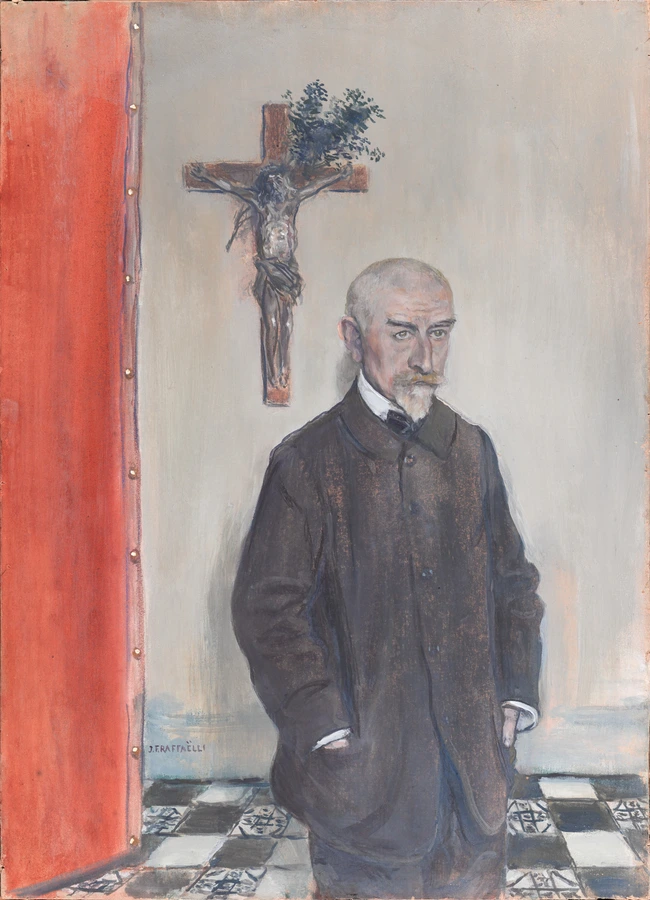
Portrait of Joris-Karl Huysmans by Jean-François Raffaëlli
Among the great literary converts of the last century’s Catholic revival, Joris Karl Huysmans is a crucial French figure. Overtaken by seasonal blues, I resolved to dive in the monstrous beauty that is so specific to his work, a sort of synthesis between Edgar Allan Poe, Charles Baudelaire and Stéphane Mallarmé. Faithful to his methodological backwardness, I started with the end: the last book of his conversion series of a character named Durtal. After The Oblate, published in 1903, I walked my way back to À Rebours, published in 1884.
Both pieces seem remarkably close to the author’s personal life as Huysmans usually steered clear from stories imagined from scratch. À Rebours follows the lethargic life of Des Esseintes, a rich young man affected by le mal-du-siècle, a popular cocktail of disgust, emptiness and apathy, while The Oblate relates the Benedictine life of a not-so-new convert as French monasteries are forced into exile. More than the sheer vastness of Huysmans’ expertise on various forms of art and on obscure historical and liturgical facts, what struck me was the utter honesty of a man who has been through all the stages of conversion: misplaced hopes, hitting rock-bottom, illumination, extreme zeal, slow changes, and finally making peace with an old self who is taking a long time to die…
In the character of Durtal, we find the perfect opposite of Des Esseintes, and yet, we sense that our convert was once that very aimless man as well. On one side, we find the decadent artist, living a life of extreme refinement to the point of sickness and folly, on the other, the humbled writer seeking balance between a simple monastic routine and the flexibility to follow his inspirations in a world set on destroying both. However, the ghost of Des Esseintes is never too far off from a Durtal prone to discouragement and melancholy, especially as he is challenged by an unstable political context and a seemingly decaying Church.
Furthermore, as À Rebours constitutes an encyclopedic novel allowing Huysmans to expand in numberless commentaries on topics such as the writings of Antiquity, the paintings of Gustave Moreau and the art of botany, so The Oblate represents an opportunity for our author to share in depth his vision of Benedictine spirituality. It has been said that the Catholic imagination is liturgically formed and informed, and there is in Huysmans a great illustration of this argument. Indeed, the charism of the Order of Saint Benedict is often thought to be the liturgy, or divine praise. While Huysmans gladly accepts this definition, he also proposes as a particularly Benedictine mission the renewal of Catholic art. This, he would argue, is only the logical progression flowing from a love for the beauty, the details, and the history of a living and breathing liturgy.
For Benedictines, the divine praise offered to God through psalms, hymns, and canticles, is translated in the idea of “le luxe pour Dieu” which is then echoed in countless crafts, from viticulture and gastronomy to architecture and manuscript illumination. The slow and steady refinement over centuries of the most minute tasks such as gardening, cooking, writing or sewing, effectuated by countless religious men and women absorbed in the prayerful praise of the Most Holy Trinity led to the creation of masterpieces transpiring with divine beauty. This is partly how Western monasticism played such an important role in the building of European civilization, and it could also be why Catholicism still has a great part to play in elevating modern
culture.
Moreover, there is a cosmic dimension to divine praise which is evident in most monasteries: birds, dogs, horses, carrots, cabbages and stars all seem caught up in universal worship, as the monks and nuns give them a voice with which to thank God. For a man like Huysmans, overwhelmed by unharmonious sights and sounds, such a reconciliation of all things could only be deeply moving. And while we recognize that as fallen humans, the struggle for peace continues within the self, the monastery, the city, and the nation, we also find with Durtal the way to keep going: humility and gratitude in a true obedience to the will of God, revealed to us through the unpretending present moment. The variety of temperaments and idiosyncrasies in the monks, the afflictions of disease, unjust laws, Church politics gone sour and smalltown drama all become bearable as our protagonist learns to forgive and follow Christ on the often unimpressive way to self-emptying. Yet as a warning for overenthusiastic believers who would expect to embrace the Cross in one second, Huysmans reminds us that the way, even in the cloister, is often long-suffering: “il faut souffrir pour aimer et souffrir encore lorsque l’on aime !”
To conclude, I will not deny that Huysmans can at times be a challenging author, encouraging us to exercise the patience he is evoking by being prone to descriptions and digressions. However, any lover of art and liturgy will find in him a friend, maybe disagreeing with his criticisms once in a while, but only doing so with the sense of respect due to those with whom we differ in matters of taste only. For those interested in a renewal of Catholic art and in what truly constitutes the Catholic imagination, Huysmans will prove to be a mentor, possibly a visionary. And who knows, he may also inspire a few with the simple joy of living under the rule of a spiritual Father so simply discreet, balanced, and straightforward as Saint Benedict!